
On February 28, 2026, the confrontation between Israel and Iran entered dangerous territory. One of the most perilous moments the Middle East has seen in decades. Israel announced a pre-emptive strike on Iranian targets. Soon after, U.S. President Donald Trump confirmed that American forces had begun “major combat operations in Iran.” That statement changed everything. This is no longer a shadow conflict. No longer a proxy chess match. It is open. Direct. Strategic. And global in consequence.
For years, the rivalry simmered below the threshold of full war. Cyber attacks, Assassinations, Maritime sabotage, Proxy battles in Syria and Lebanon, Each side probing testing limits, avoiding the final step. The 12-day air war in June 2025 cracked that restraint. February 2026 may have shattered it.
The latest strikes are not symbolic. They reflect calculation. A belief in Jerusalem that waiting carries greater danger than acting now. Especially as Iran has advances its nuclear and ballistic missile programs.
With Washington now directly involved, the scale has changed. What was once a regional confrontation risks becoming a systemic rupture in the international order.
For More Current Updates on this conflict https://www.aljazeera.com/news/liveblog/2026/2/28/live-israel-launches-attacks-on-iran-multiple-explosions-heard-in-tehran
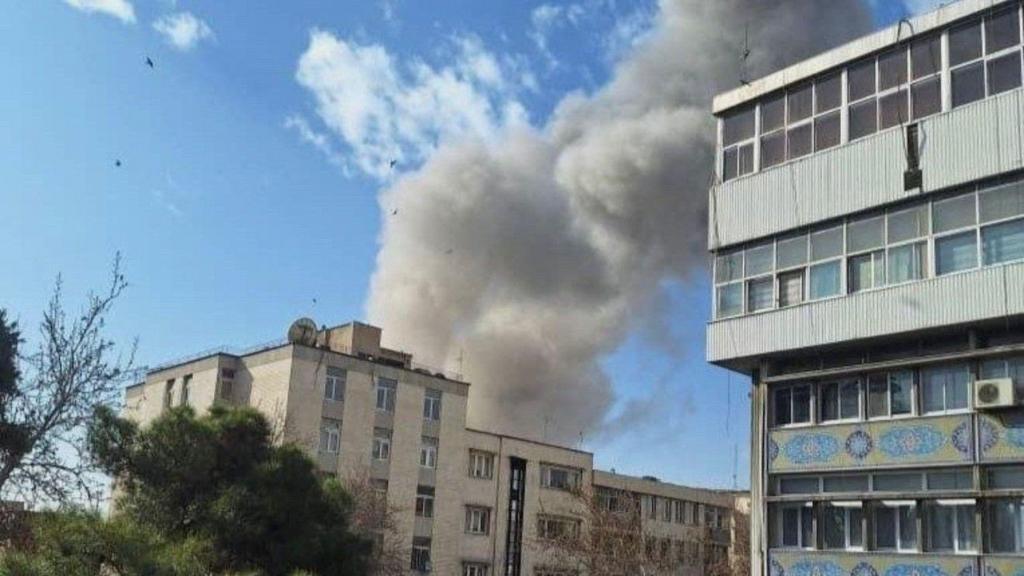
Image Curtesy: BBC
Strategic Geography and Military Dynamics
Geography matters here. Deeply.
Israel and Iran do not share a border. They are separated by distance roughly 1,500 kilometers. This is a war of aircraft, long-range missiles, drones, cyber capabilities, networks rather than trenches. Iran holds a significant ballistic missile arsenal capable of reaching Israeli territory. Israel, in turn, relies on layered air defense systems and superior air power.
But the real danger is not one decisive strike. It is the spiral action reaction escalation and Counter-escalation. Even more destabilizing is Iran’s regional network. Hezbollah in Lebanon, armed groups in Iraq and Syria, Houthis in Yemen, if activated fully, the conflict stretches from the Mediterranean to the Red Sea. One battlefield becomes many.
Arab Gulf Anxiety: The American Base Dilemma
Across the Arab Gulf, anxiety is rising.
Countries like Bahrain, Qatar, Kuwait, and the United Arab Emirates host major American military installations. Air bases, Naval facilities, Logistics hubs, these bases are strategic assets for Washington. But in times of escalation, they also become potential targets. For Gulf governments, this creates a strategic paradox. They depend on American security guarantees. Yet those very guarantees increase their exposure if Iran chooses to retaliate beyond Israel. A missile aimed at a U.S. base in the Gulf would not just be an attack on Washington. It would strike Arab soil. It would endanger civilian infrastructure. It would destabilize domestic politics. Leaders in the Gulf must now calculate carefully. Publicly, they may call for restraint. Privately, they worry about being drawn into a war they did not choose.
The memory of past regional conflicts still lingers. Economic diversification plans. Tourism growth, Foreign investment, all depend on stability. A wider war threatens those ambitions. The fear is simple: becoming collateral geography in a confrontation between larger powers.
The Strait of Hormuz and the Energy Factor
Then there is the Strait of Hormuz. Narrow. Strategic. Indispensable.
Nearly one-fifth of the world’s traded oil flows through that passage. A missile threat, a naval incident, even rumors of mining operations all would send markets into shock. Oil prices would surge. Insurance costs would rise. Supply chains would tighten. For energy-importing nations like India, Japan, much of Europe, the impact would be immediate. Not abstract, Not distant, Immediate. This war would not remain confined to military maps. It would travel through fuel pumps and inflation charts.
Great Power Implications
The crisis exposes the fault lines of the emerging multipolar order.
Russia may lean diplomatically toward Tehran. Possibly deepen military cooperation. China faces a dilemma. It depends heavily on Gulf energy. It values its strategic ties with Iran. Yet it must avoid direct confrontation with the United States. If the United Nations Security Council stalls under veto divisions, confidence in multilateral institutions will erode further. This is not just a regional clash. It is a stress test for global governance.
Domestic Political Calculations
Inside Israel, national security crises often create temporary unity. Inside Iran, external pressure reinforces the government’s narrative of resistance. In the United States, decisive action may project strength at first. But prolonged engagement carries risks. Fatigue, Polarization, Strategic overstretch. Each leadership faces domestic pressures that could either cool tensions or intensify them.
A Structural Shift
February 2026 may mark a turning point.
Hard power is returning to the forefront of Middle Eastern politics. Diplomatic containment is weakening. The line between regional rivalry and global strategic competition is fading. For South Asia and other energy-dependent regions, this is not a distant conflict. It is economically proximate and strategically consequential. Whether this moment becomes a contained crisis or the beginning of a broader war depends on decisions taken in the coming weeks. But one reality is already visible: the Israel–Iran confrontation has moved into open geopolitical contestation. And the entire region including cautious Arab states hosting American bases now waits, uncertain, calculating, exposed.